
A Surprisingly Deep Free Strings Library
Every composer has that moment where a new virtual instrument loads up, you play a single note, and you immediately lean back thinking, Oh… this is going to be good.
That was my first reaction to LUX Orchestral Strings Elements, Sonuscore’s latest free orchestral strings library for the free Kontakt Player. And honestly, I wasn’t expecting to feel that way about a freebie.
But LUX Elements isn’t built like a typical “entry‑level” string VST. It feels alive. It feels intentional. And it feels like Sonuscore genuinely wanted to give composers something inspiring rather than something promotional.
Kontakt Interface: A Solar Eclipse That Actually Feels Musical
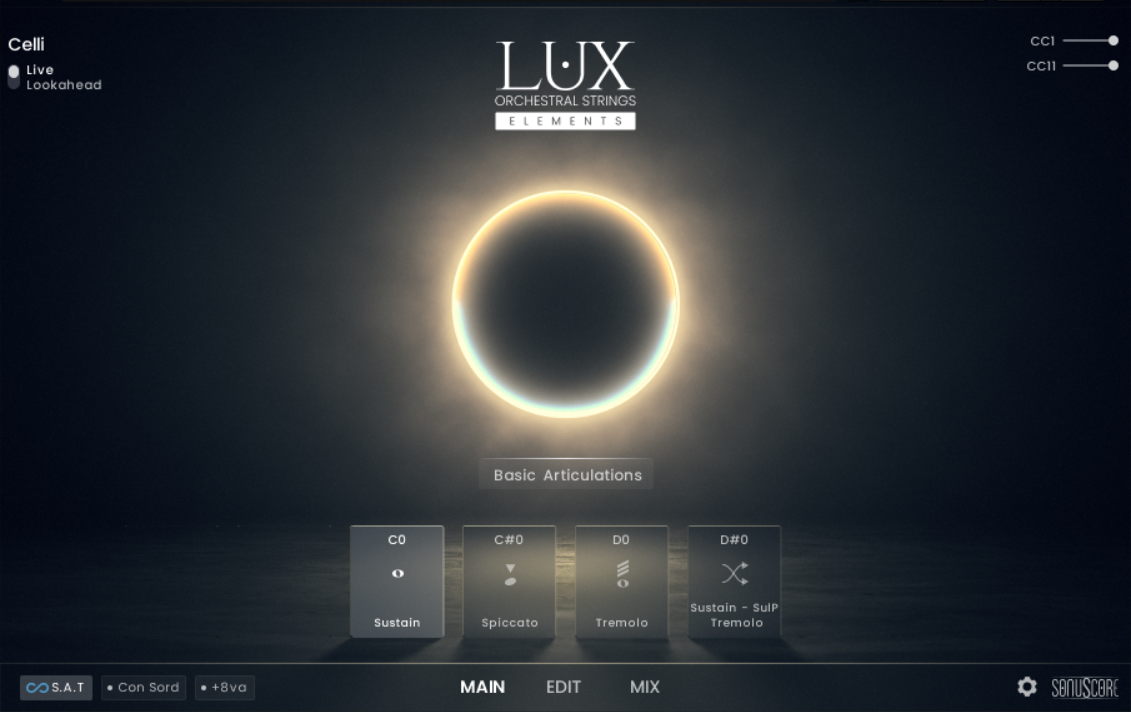
Let’s start with the interface, because it sets the tone before you even touch the keyboard. The whole visual design is based on a solar eclipse – a glowing ring that opens and closes as you ride the modwheel. It’s subtle, but it’s hypnotic. And more importantly, it mirrors the dynamic layers of the samples in a way that makes you want to perform.
Push the modwheel and the eclipse expands, the strings swell, and suddenly you’re not just triggering samples – you’re shaping a moment. It’s one of the most responsive free Kontakt libraries I’ve played in a long time.


Four String Articulations, All Killer, No Filler
Each section – Violins I, Violins II, Violas, Celli and Basses – comes with four articulations:
- Sustain
- Spiccato (with multiple velocity layers + round robins)
- Tremolo
- Sustain + Sul Ponticello Tremolo blend
That last one deserves its own paragraph.
The sustain + sul pont tremolo patch is a little chaotic, a little unstable, and absolutely brilliant. At low dynamics, it’s this smooth, shimmering texture. Push the modwheel and it becomes a tense, almost frantic tremolo that feels perfect for horror scoring, psychological thrillers, dark ambient or experimental game soundtracks.
It’s the kind of articulation you don’t expect in a free orchestral strings library – something that isn’t just functional, but creatively inspiring.
And yes, the longer articulations have multiple dynamic layers, so the modwheel transitions feel slick and expressive.
LUX Elements also includes a one‑octave legato patch for the first violins. It’s small, but it’s musical – great for sketching melodies or layering into bigger arrangements.
The Sound: Cinematic, Intimate, Spacious and Surprisingly Elegant
Tonally, LUX Orchestral Strings Elements sits in a beautiful middle ground. It’s not bone-dry and clinical, but it’s not drenched in reverb either. The natural room tone gives the strings a sense of space – a kind of airy, concert hall glow – without muddying the details.
The reverb tail is long enough to feel cinematic, but not so long that it swallows fast passages. It’s the kind of sound that instantly feels “finished,” even before you touch any effects.
As someone who usually prefers raw, dry samples so I can sculpt them myself, I was surprised by how much I liked the default tone. It’s polished without being overproduced – a rare balance in free Kontakt libraries.
Mixing Tools That Actually Matter
Sonuscore kept the effects simple but useful:
- Three reverb presets (Hall, Room, Small Room)
- 3‑band EQ
- Compression
- Velocity and volume curve controls
- Release envelope
- Humanize function (adds subtle timing variations for realism)
There are no multiple microphone positions – instead, you get a pre‑mixed perspective that blends close and room mics into a single, cohesive sound. And honestly, it works. It’s clean, balanced, and ready to drop into a mix.
Two extra controls sit at the bottom left:
- Con Sordino – a muted strings effect that softens and warms the tone
- 8va Toggle – layers a higher octave
Both are simple, but they expand the palette in meaningful ways.
Six Presets, One Cohesive Sound
LUX Elements includes:
- Violins I
- Violins II
- Violas
- Celli
- Basses
- First Violins Legato
It’s everything you need to sketch full string arrangements with a unified sonic identity.
Final Thoughts: This One Stays in the Template
LUX Orchestral Strings Elements isn’t just “good for a free library.” It’s good, period.
It’s expressive, cinematic, beautifully recorded, and genuinely inspiring to play. Whether you’re scoring films, writing for games or building atmospheric soundscapes, this library gives you a polished orchestral foundation without costing anything.
Sonuscore didn’t phone this one in. They gave composers something with personality – something that breathes, reacts and invites creativity.
And that’s why LUX Elements isn’t going into my “freebies” folder.
It’s going straight into my template.
LUX Orchestral Strings Elements is simple to get up and running: it installs through Native Access, requires the free Kontakt Player 7.10.9 or higher and takes up about 3.5GB once installed. Native Instruments Kontakt runs both as a standalone app and as a plugin in all major formats (VST 3, AU, AAX) so whether you’re on Windows PC or macOS, the library slots easily into any modern DAW setup.
To download LUX Orchestral Strings Elements for free, head to the Sonuscore website using the link below and complete the checkout process – you’ll need to create an account and provide an email address to receive your serial number, which you’ll then activate through Native Access.
The Orchestra Elements
In 2024, Sonuscore released The Orchestra Elements, a free compact version of their commercial orchestral engine – also for Kontakt Player – that focuses on quick inspiration and easy ensemble writing. It lets you layer strings, brass, woodwinds and percussion into ready‑to‑play patterns and textures.
A Wave of New Free Orchestral Libraries
In the last few years, there’s been a noticeable rise in genuinely high‑quality free orchestral libraries – everything from full ensembles to specialized sections and experimental textures. It’s gotten to the point where composers can build surprisingly capable templates without spending a cent. Which reminds me that I really need to update my free orchestral library compilation – so stay tuned for that!


